In shortAntelope Canyon light beams form in Upper Antelope Canyon when the sun climbs high enough to drop through the narrow opening overhead and reach the floor about 120 feet (37 m) below. An authorised operator puts the window at April through September, on clear, sunny days only, and names the 11:20 a.m. departure as the best chance. Time inside is capped at two hours.
April–SeptemberUpper Antelope beam window
11:20 a.m.Departure named best chance
120 ft (37 m)Depth the light must reach
from $119Upper tour listed here
How the shafts of light form
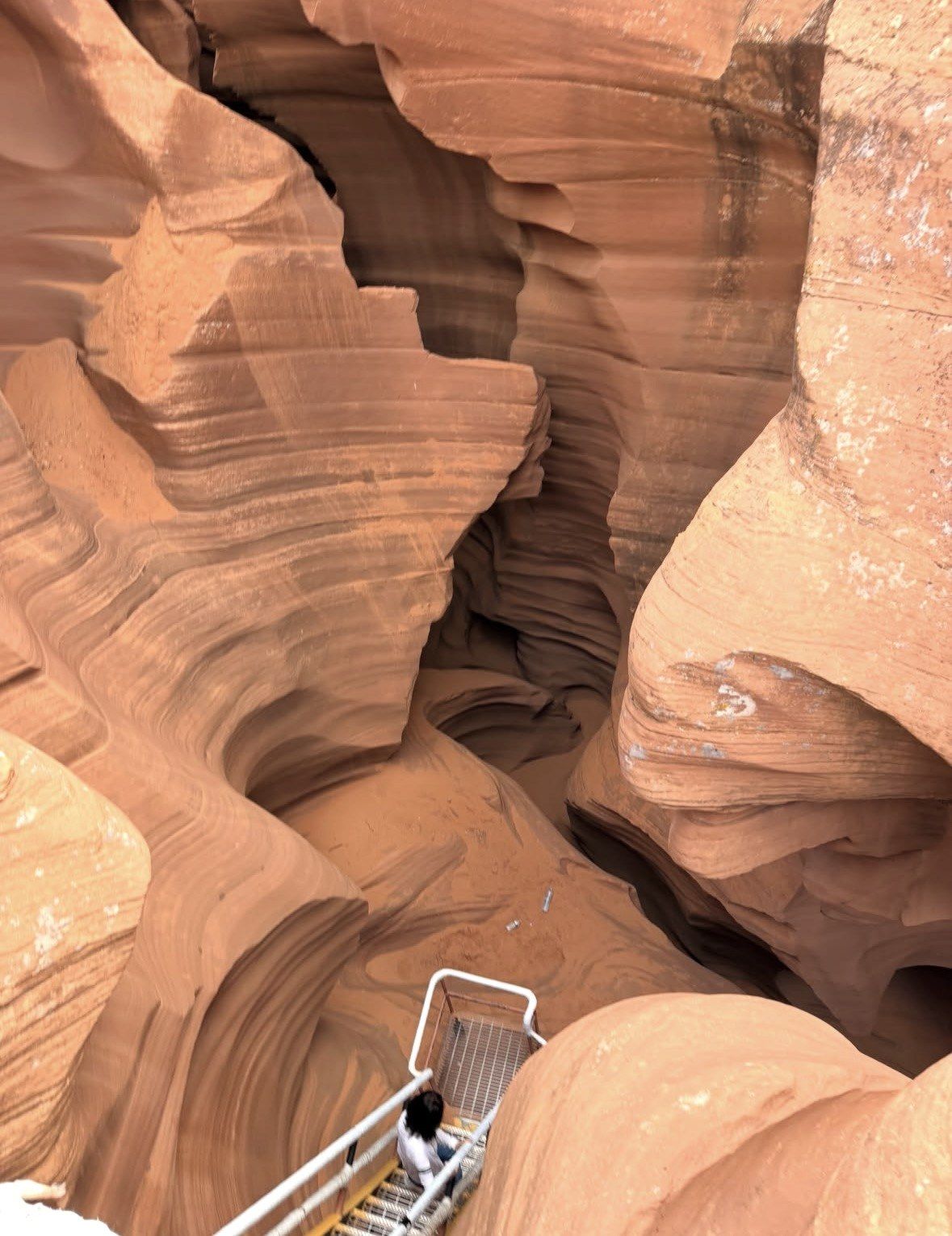
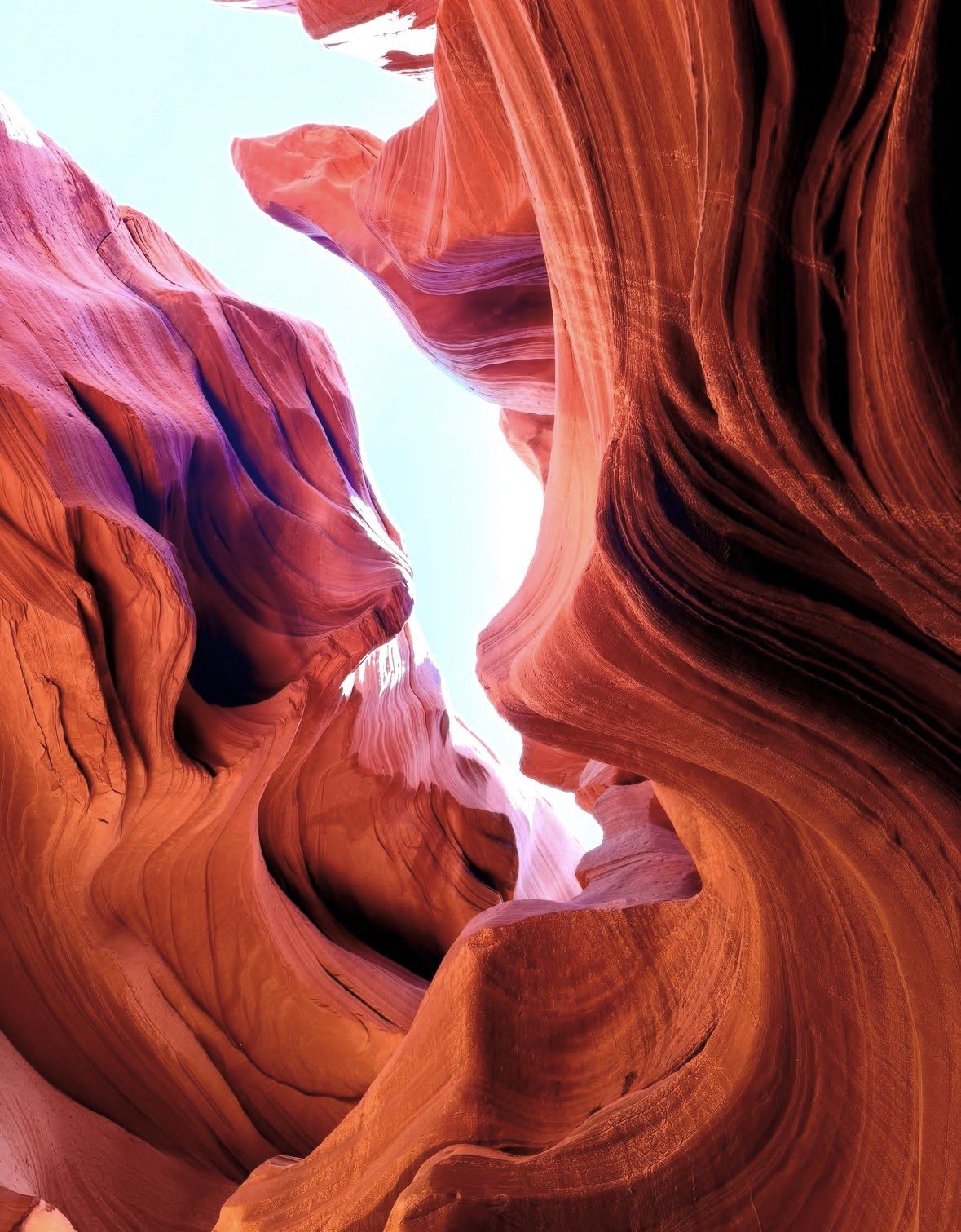
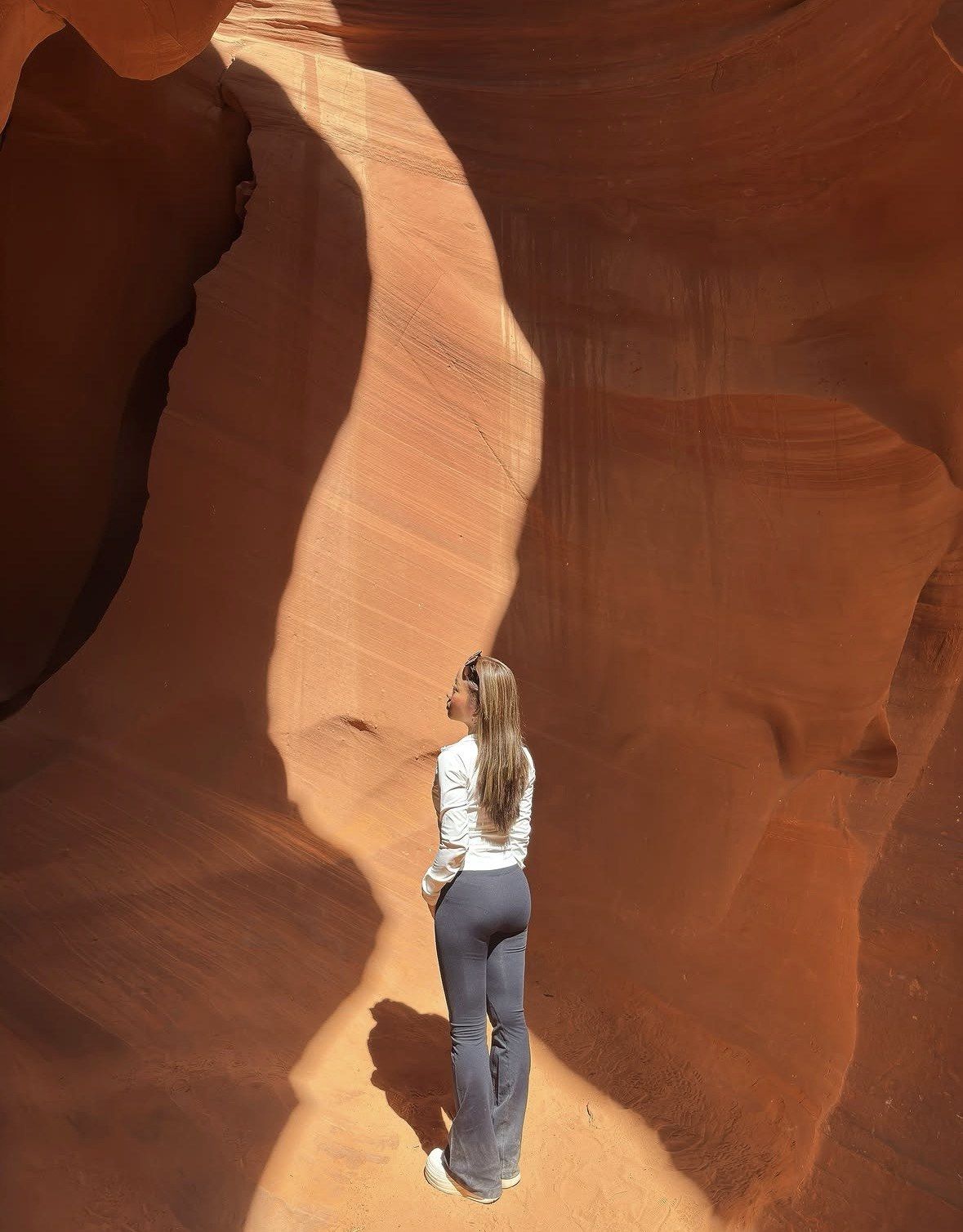
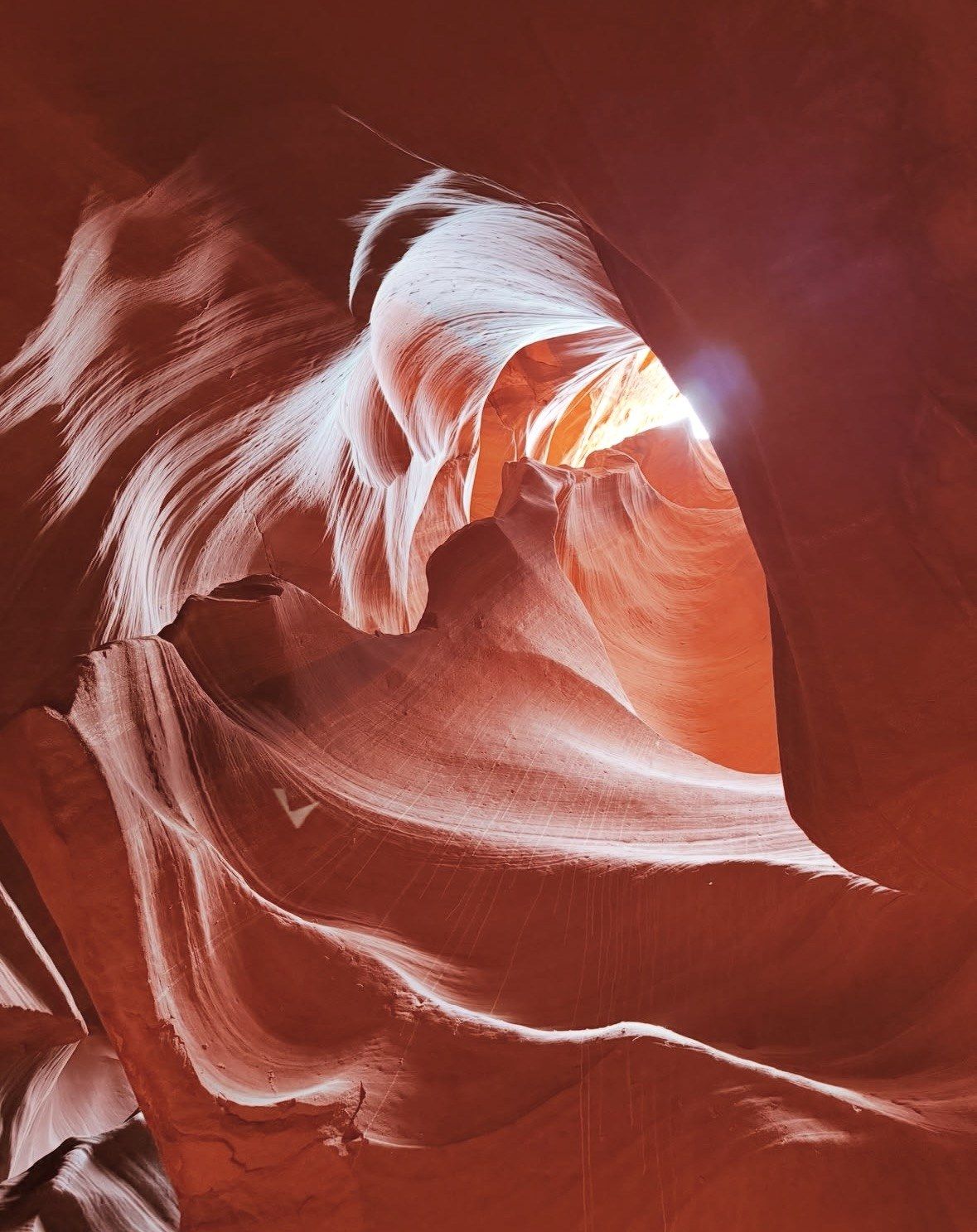
A beam is sunlight that has found a gap in the roof of the slot and travelled all the way down to the sand. The canyon is cut about 120 feet (37 m) into the rock and the opening above is a crack rather than a window, so the sun has to be close to overhead for the light to clear both walls. Earlier and later in the day that same sun lands on the upper walls, bounces between them and fills the passage with reflected orange and purple glow. It photographs well, and it is not a beam.
Dust does the other half of the work. The floor you walk on is sand, feet lift fine grit into the air, and the particles scatter the light sideways so the column itself becomes visible from the side. Clean, still air would give you only a bright oval on the ground. That is why a beam looks stronger a few seconds after a group has moved through, and why it fades as the dust settles.
The rock doing the shaping is Navajo Sandstone, put at roughly 8 to 60 million years old and opened out mainly by flash flooding, which is what produced the narrow top and wider base. The canyon floor sits at 3,704 feet (1,129 m).
Upper Antelope Canyon Tour-AACT
This is the tour on this site that goes into the beam section itself: from $119 for 1 hour 20 minutes, all fees and taxes included, 4.7 ★ (2140 reviews), with free parking at the meeting point and a 30-minute check-in.
★ 4.7/5 · 2,140 reviews
Why Upper Antelope Canyon sunbeams appear in one section only
Of the two main sections, only Upper Antelope carries a published beam season, and its Navajo name is Tse'bighanilini. Its walkable corridor runs about 660 feet (200 m) and is now covered as a one-way route, and it is the section for which an authorised operator publishes a beam window of April through September, on clear, sunny days only.
Lower Antelope is a separate canyon and not the other end of the same walk. It gives you about 1,335 feet (407 m) of passage, which Navajo Parks describes as narrow with steep stairs, and no beam season is published for it. Beams do also form in Antelope Canyon X, which its operator dates from May through early August on clear days and whose busiest visiting hours run between 10:30 a.m. and 1:00 p.m.; check-in for it sits farther east, at Milepost 308 on Highway AZ-98.
If the beams are the reason you are making the trip, book Upper and accept that it is the shorter walk of the two. Outside the published months you are paying for a short one-way corridor and reflected light, which is worth seeing but will not match the photographs that sold you the idea.
Antelope Canyon beam season, month by month
April through September is the window, and the edges of it are weaker. At the shoulders of the season, early April and late October, the shafts come out narrower and die away faster, because the midday sun never climbs far enough to push light deep into the slot. Mid-season gives the steepest sun angle and the longest-lived shafts.
Weather is the variable nobody controls. The strongest beam months overlap the Arizona monsoon, which the National Weather Service dates from 15 June to 30 September, with the moisture usually arriving in northern Arizona during the first week of July, and Navajo Nation Parks states in capital letters that bad weather can shut the canyons with no notice. Roughly 40 to 50 percent of the year's rain falls on much of northern Arizona inside that span, and a cloudy sky over Page at the wrong hour ends the beams even when the canyon stays open. Take one of the earlier beam-season departures in July, August and September, hold a spare half-day for a second attempt, and accept a closure without trying to argue your way in.
For comfort against beam quality, May and September are the sweet spots: Page averages a daily maximum of about 79.1 °F in May and 84.3 °F in September, against 90.6 °F in June, 96.0 °F in July and 92.8 °F in August. June is the driest month on the Page record at roughly 0.20 inch, August among the wettest at about 0.67 inch.
- April: window opens, but early-April beams are smaller and shorter; Page averages about 69.1 °F by day
- May: full beam season, averages about 79.1 °F, and the Antelope Canyon X window opens too
- June: driest month at roughly 0.20 inch, high sun, and the monsoon season officially begins on 15 June
- July and August: strongest sun angle, hottest days near 96.0 °F in July, and the highest chance of a weather closure
- September: last month of the published Upper window, averages about 84.3 °F, monsoon ends on 30 September
- October onwards: late-October beams are smaller and brief, and no beam season is published for the winter months
Which departure to take, and the clock to set your watch by
Upper Antelope runs on set departure times. One authorised Upper operator publishes April-to-September departures at 7:50 a.m., 9:50 a.m., 11:20 a.m., 12:00 p.m., 2:00 p.m. and 4:10 p.m., and names the 11:20 a.m. tour as the one giving the best chance of beams. Another publishes 8:20 a.m., 10:40 a.m., 1:00 p.m. and 3:20 p.m. plus an 11:40 a.m. premium slot in beam season. Timetables differ between authorised operators and can change, so read your own departure time off the ticket rather than from a schedule you saw elsewhere.
Midday costs more in beam season. Published beam-season pricing for Upper puts the 11:40 a.m. premium slot at $120 against $100 for the standard Upper tour, which is the price of the hour when the sun is nearest overhead. Pay it in summer, when the beams are actually possible. In any other month that same hour buys you the busiest part of the day and nothing else.
Beam departure times are quoted in Arizona time, Mountain Standard with no daylight saving, while the surrounding Navajo Nation does move its clocks. The hour a beam appears therefore stays the same between spring and autumn, and a phone that has picked up the wrong zone can read an hour ahead of your actual departure. Check in 30 minutes before the Upper departure time and work from a watch you set yourself.
| What to check | Beam season detail |
|---|
| Section with beams | Upper Antelope Canyon, the 660 ft (200 m) one-way corridor |
|---|
| Months | Cloudless days only, from April to September |
|---|
| Departure named as the best chance | The 11:20 a.m. tour, among one operator's published April-to-September times |
|---|
| Premium beam-season slot | An 11:40 a.m. slot published at $120, against $100 for the standard Upper tour |
|---|
| Clock | Arizona time, Mountain Standard, the same hour all year |
|---|
| Check-in | 30 minutes before the Upper departure time |
|---|
| Time inside | Two hours maximum, a limit in force since 1 May 2011 |
|---|
| Camera support | Tripods and monopods are not permitted inside |
|---|
What happens inside, and what you can carry
Upper is walked in one direction, so the group moves forward with the guide and nobody doubles back for a second look at a beam that was better thirty seconds ago. Expect roughly an hour on foot inside, with the park cap of two hours on time in the canyon in force since 1 May 2011. Beams come and go as cloud passes and as the sun shifts off the opening, so when one is standing in front of you, shoot it then.
Camera rules are tighter than people expect. Shooting a beam means shooting handheld: tripods, monopods and selfie sticks all stay outside Upper Antelope, and Navajo Parks & Recreation has stopped issuing photography and filming permits for Upper and Lower Antelope. Any bag you take into Upper must be transparent, and opaque bags may not be tucked inside a clear one. Carry a phone or camera, water and cash for the tip in your pockets, and leave the rest in the car.
A Navajo guide is compulsory everywhere in the canyon, with no self-guided or walk-in-on-your-own access, and tribal park entry is charged at $15 per person, per entry, separately from guided tour prices. The Upper tour listed on this site has all fees and taxes in the price. Closed-toe walking shoes and a light layer make sense for a midday beam tour, because the sandstone holds the inside cool while Page runs to a July average daily maximum near 96.0 °F, and the way out finishes with 150 stairs back up to the vehicles.
- Beam tours board at the Upper entrance on Highway 98, some three miles east of Page, where 4x4 vehicles pick groups up
- Allow about 90 minutes in total, roughly 15 minutes of driving each way plus around 60 minutes in the slot
- The tribal park's own page gives summer hours of 8:00 a.m. to 5:00 p.m. and publishes nothing for winter
- No visits on Thanksgiving Day, Navajo Nation Family Day, Christmas Day or New Year's Day, all outside the April-to-September window
- Drones, dogs, rock climbing and littering are prohibited across Navajo park lands, and alcohol across the Navajo Nation
Questions people ask
Are the light beams guaranteed if I book a midday tour in summer?
No. The operator that publishes the April-to-September window states plainly that beams show on clear, sunny days only, so cloud over Page at the wrong moment is enough to end the show. Bad weather can also shut the canyons at short notice, which Navajo Nation Parks sets out on its own page. Book a morning or midday slot, keep a flexible half-day, and treat the beams as a good chance rather than a certainty.
How long does a single beam last once it appears?
Minutes, and it changes shape the whole time as the sun moves off the opening above. An early-April or late-October beam is narrower and finished sooner than a midsummer one. Because Upper is walked in one direction, you see what is in front of you when you reach it, which is the main argument for taking the departure nearest the top of the sun's arc.
Can I see light beams in Lower Antelope Canyon?
No beam season is published for Lower Antelope. The window of April through September is stated for Upper, and Antelope Canyon X has its own window of May through early August on clear days, with the popular visiting hours between 10:30 a.m. and 1:00 p.m. Lower is the longer walk, about 1,335 feet (407 m), and Navajo Parks describes it as narrow with steep stairs.
Do I need a photography permit to shoot the beams?
Photography and filming permits are no longer issued for Upper or Lower Antelope Canyon by Navajo Parks & Recreation, which cites crowding and safety, and applications are not being accepted for Antelope Canyon X either. Cameras and phones are fine on a normal guided tour. Tripods and monopods are not allowed inside Upper, so plan on handheld shooting at a high ISO.
Can I walk into the beam section on my own if I arrive at the right hour?
No. The beam section, like every other location in the canyon, opens only with a Navajo guide, and any part of the Lake Powell tribal park area is reached on a guided tour booked with a licensed operator. Entry to the tribal park costs $15 per person for each entry and sits outside the guided tour price, and the canyon falls outside Glen Canyon National Recreation Area, so America the Beautiful and Glen Canyon passes buy you nothing here.
Read also