In shortBring the camera or the phone and leave every support in the car: no tripod, monopod or selfie stick goes inside, one of the two Lower Antelope operators turns away professional camera equipment as well, and the permit route is closed because Navajo Parks issues no photography or filming permits at Upper or Lower Antelope. Shoot handheld, brace against the wall, expose for the lit sandstone rather than the opening above, and take a side-canyon or Antelope Canyon X photo departure if you need time.
120 ft (37 m)depth above the floor
No tripodshandheld shooting only
2 hourscap on time inside Upper
About 3 hoursCanyon X photo departure
Which camera gear you can take inside the canyon
Cameras and phones go in with you. Tripods, monopods and selfie sticks stay behind: at Upper Antelope the licensed operator permits cameras and bans all three inside the canyon, and any bag you carry has to be transparent, with no opaque bag tucked inside a clear one. Lower Antelope is stricter in one respect. One of the two licensed operators there bars tripods and professional camera equipment on every one of its tours, so a large body with a bag of fast glass can be turned away at check-in rather than carried through the stairs.
Crowding and safety ended the permit route photographers once used: there is no photography or filming permit left to apply for at Upper or Lower Antelope Canyon, and Navajo Parks & Recreation is not taking applications for Antelope Canyon X either. The tripod departures that photographers once booked into Upper and Lower no longer run, so you walk with a sightseeing group and shoot handheld.
Two rules matter before you plan a shot list. A Navajo guide is compulsory at every location in the canyon, and drones are prohibited across all Navajo Nation Parks land, along with rock climbing and dogs. Tribal park entry costs $15 per person, per entry, separate from the tour price, so check which of the tours listed here covers it.
| Section | Cameras and phones | Bags | Tripods and poles |
|---|
| Upper Antelope | Allowed | Transparent bags only; opaque bags may not be placed inside them | Tripods, monopods and selfie sticks banned inside |
|---|
| Lower Antelope | Allowed; one licensed operator bars professional camera equipment | One site bans all bags, including clear ones, a rule in force since 4 May 2023 | Tripods banned on all of that operator's tours |
|---|
| Antelope Canyon X | Allowed; the operator advises bringing only water and a phone or camera | No bags of any kind on the hiking tour, hydration packs included; photo-tour guests may bring one camera bag each | No published rule |
|---|
Where the dedicated photo departures run now
Photography departures have shifted to the side canyons and to Antelope Canyon X. Among the licensed Upper Antelope operators, one still sells two photography departures, a Night Photography Tour and a 3-Canyon Photography Tour, and neither takes anybody under 21. Antelope Canyon X and Cardiac Canyon have a single licensed operator, Taadidiin Tours, whose Antelope Canyon X photography tour lasts about 3 hours and takes ages 8 and older. The standard X hiking tour runs about 1.5 hours and allows no bags at all, which is the practical difference between the two departures if you are carrying glass rather than a phone.
Antelope Canyon X suits a photographer beyond the gear allowance. You check in for it out at Milepost 308 on Highway AZ-98, a longer drive east than either the Upper or the Lower entrance, so build those extra minutes into a morning shoot. The floor is sandy, with no ropes or ladders, and a staircase of about 200 feet built from railroad ties handles entry and exit. Light beams there run May through early August on clear, sunny days, with the popular window from 10:30 a.m. to 1:00 p.m.
Waterhole Canyon, south of Page, has a photography tour run by a Navajo family-owned operator. Each canyon's own licensed operator sells those side-canyon departures. The tours listed on this page go into Lower and Upper Antelope, where you shoot handheld inside a moving group.
Upper Antelope in the beam window
If your target shot is a beam on the canyon floor between April and September, this is the tour on this site that goes into that section: from $119 for 1 hour 20 minutes, 4.7 ★ (2140 reviews), all fees and taxes included, free parking where you meet the guide and a 30-minute check-in.
★ 4.7/5 · 2,140 reviews
Antelope canyon photography tips for shooting handheld in low light
Your own body is the tripod. Put your back or shoulder against the sandstone, elbows into your ribs, strap taut against your neck, breathe out and shoot a short burst instead of a single frame. The first 400 metres of Upper Antelope are level sand with no ladders, so kneeling or sitting for a low angle up the corridor is easy.
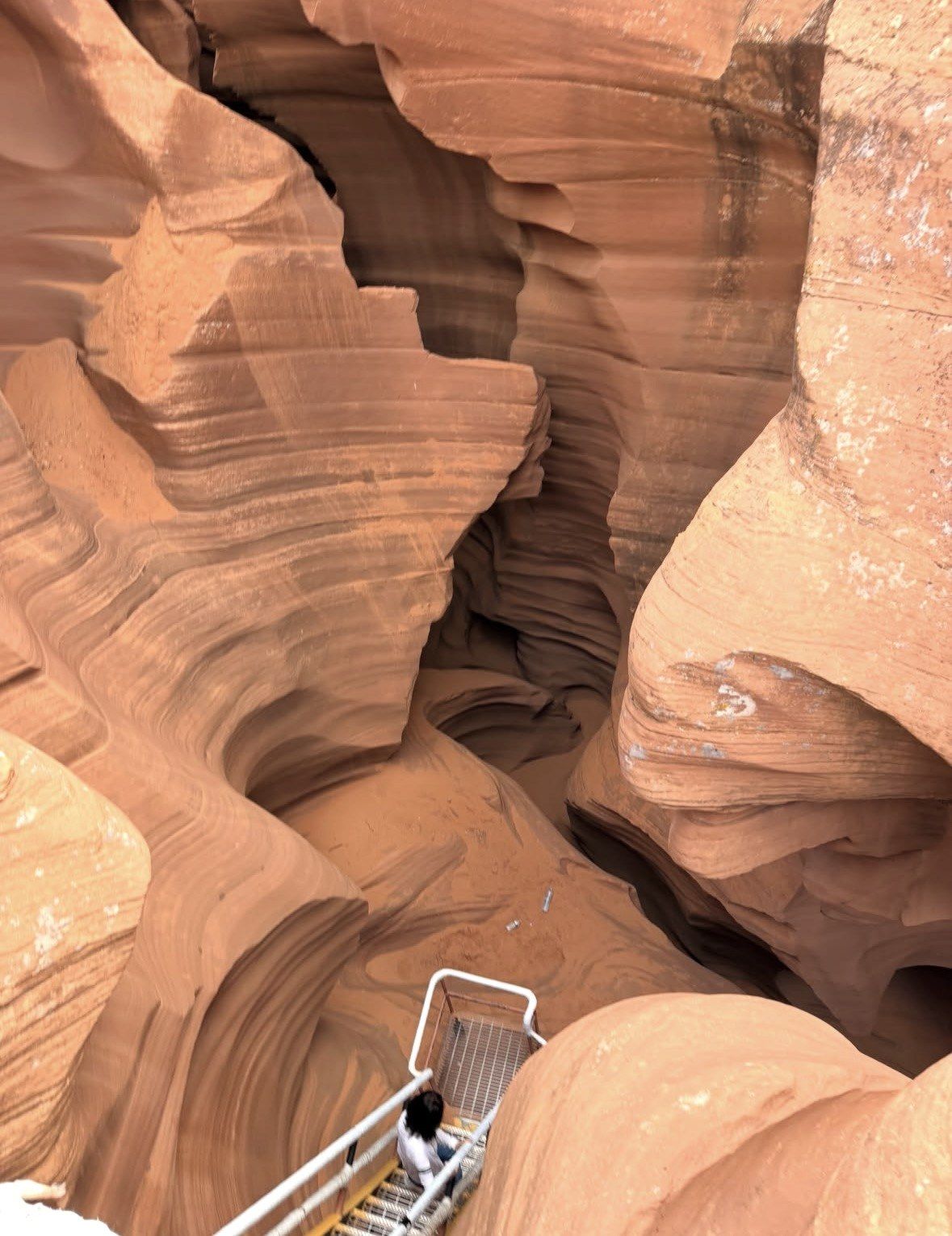
Favour a fast shutter over a clean file. In a corridor cut about 120 feet (37 m) into the rock, a sharp noisy frame beats a smooth smeared one, and noise cleans up far better in editing than motion blur does. Shoot raw. Keep continuous autofocus off flat wall, put the focus point on an edge where the light falls, and push the ISO as far as your body will stand before you let the shutter drop.
Phone shooters have the easier time here. Nothing you carry breaches the rules, and the whole kit fits in a pocket at the sites where bags are restricted or banned. Night modes want you still for the length of the capture, so brace the same way. Keep the flash off, since it kills the bounced glow that makes these walls work, and wipe the lens before each sequence, because airborne grit films it over within minutes.
- Brace against a wall or drop to a knee on the sand instead of reaching for a support you are not allowed to use
- Shoot bursts and keep the sharpest frame
- One lens on the body, chosen before you walk in
- Strap short and taut so the camera cannot swing into the rock in a narrow passage
- Flash off; the colour in these pictures is reflected daylight
- Closed-toe walking shoes, required at Lower Antelope, and a light layer because the interior stays cool
Exposure, white balance and keeping grit off the sensor
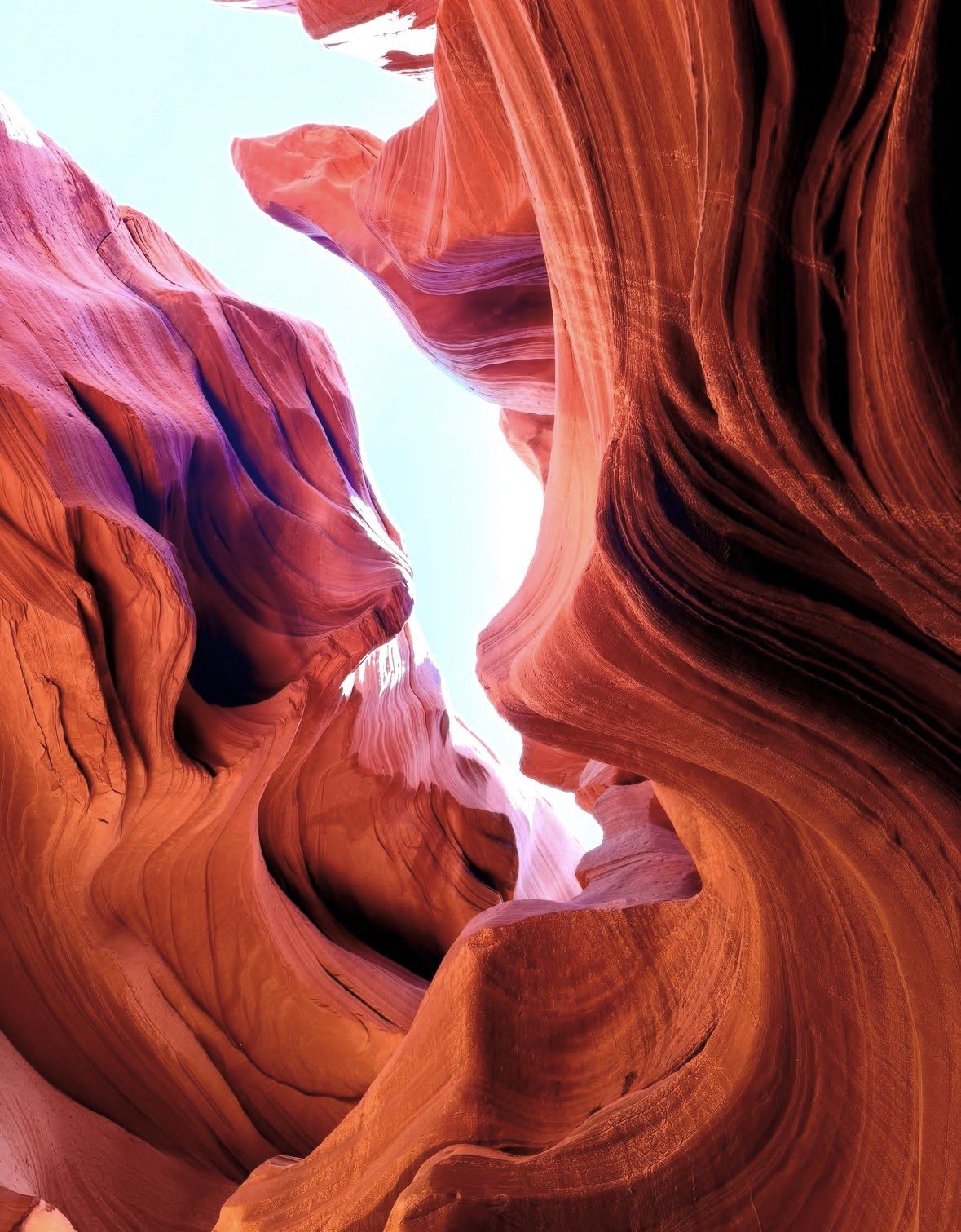
The opening overhead is far brighter than anything on the walls, so a meter reading the whole frame will underexpose the rock to protect it. Spot meter on the lit sandstone instead, accept that the crack of sky goes white, and compose so that it takes up as little of the frame as you can manage. If you want the opening to hold some detail, dial exposure down, shoot raw and lift the shadows afterwards; one file rarely holds both ends of the range in a passage cut this deep into sandstone.
White balance drifts because the light reaching you has bounced off orange rock. Auto will swing frame to frame and your sequence will not match, so lock a preset or set a custom balance and fine-tune in raw. Do not neutralise the warmth completely; the glow is what the sandstone does to daylight.
Grit is the real hazard to your kit. Fine sand drifts down from above, often stirred deliberately to make a beam show, so never change a lens inside the canyon. Point the camera at the ground between shots, keep a hood or clear filter on the front, and clean outside at the vehicles.
Compositions along the one-way route and the time you actually have
Upper Antelope is walked in one direction along a corridor of about 660 feet (200 m), so the group keeps moving and you cannot double back for a shot you missed. Work both ways as you go: shoot ahead down the passage while the group in front clears, then turn and shoot back the way you came, usually the quieter view. Time inside has been capped at two hours since 1 May 2011 and the walk takes roughly an hour, so pick three or four places to stop.
You get about 1,335 feet (407 m) of passage to work with at Lower Antelope, in what Navajo Parks calls a narrow canyon with steep stairs. Five flights drop you into the largest cavern on the tour, and ladders with handrails are bolted into the walls where you need both hands. Shoot from the cavern floor rather than from a ladder, and let the group ahead move on before you frame up.
Set your watch to Arizona time, which does not observe daylight saving, so beam timings do not shift in summer. The beam season at Upper Antelope sits between April and September, clear skies only, and the 11:20 a.m. departure is the one singled out as the best chance of catching one; shoot either shoulder, early April or late October, and the beams come out thinner and fade sooner. Summer gate hours at the tribal park are 8:00 a.m. to 5:00 p.m., the park prints its warning about short-notice closures in bad weather in capital letters, and the Arizona monsoon covers 15 June to 30 September, so hold a spare half-day in July, August and September for the shoot you lose.
For a shooting plan the choice is simple. A beam on the floor means Upper Antelope, and the Upper Antelope Canyon Tour-AACT is the tour here that goes into it: 1 hour 20 minutes, from $119, 4.7 ★ (2140 reviews), parking free where you meet the guide, check-in 30 minutes ahead. For the longer, more sculptural corridor and more frames per dollar, take the Lower Antelope Canyon Hiking Tour, from $94 for 1 hour with all fees and taxes included, 4.9 ★ (7729 reviews), checking in forty-five minutes before your time at Dixie's Lower Antelope Canyon, the first left inside the Navajo Tribal Park under the green roof. With no car in Page and frames wanted from both the canyon and the river bend, the Award-Winning Lower Antelope Canyon & Horseshoe Bend Tour runs 14 to 15 hours from $160, 4.9 ★ (8468 reviews), picking up at select hotels and covering the Navajo Nation Permit Fee, admissions, a deli lunch and Wi-Fi on board.
Questions people ask
Do I need a photography permit for Antelope Canyon?
No, because none is issued. There is no photography or filming permit left to obtain for Upper or Lower Antelope Canyon, Navajo Parks & Recreation having ended them, and applications for Antelope Canyon X are not being taken either. Personal photography on a guided tour needs no paperwork.
Can I use a drone or a gimbal in the canyon?
Drones are prohibited across all Navajo Nation Parks land, Antelope Canyon included, together with rock climbing, littering and dogs. Selfie sticks are banned inside Upper Antelope along with tripods and monopods. Assume that anything which extends, supports or stabilises the camera stays in the vehicle, and plan on handheld work.
Is a phone good enough for Antelope Canyon photos?
Yes, and in some ways it is the better tool here. Everyone shoots handheld, so the advantage of a big camera narrows, and a phone fits in a pocket where bags are restricted. Keep the flash off, brace before each capture and clean the lens often.
What is the best time of day to photograph the canyon?
In Upper Antelope the beams are mainly an April to September sight on clear, sunny days, and the 11:20 a.m. departure is identified as giving the best chance. In Antelope Canyon X beams run May through early August on clear days, with the busiest hours between 10:30 a.m. and 1:00 p.m. All times are Arizona time, which never shifts for daylight saving.
Which minimum ages apply to the dedicated photography departures?
The Night Photography Tour and the 3-Canyon Photography Tour sold by one authorised Upper Antelope operator are both restricted to ages 21 and over. The Antelope Canyon X photography tour, around 3 hours long, takes ages 8 and older, and photo-tour guests there may carry one camera bag each.
Read also